
NASA’s Curiosity Mars rover has spent greater than 13 years exploring the three.5-billion-year-old Gale crater, slowly climbing a central mound generally known as Mount Sharp. Satellite tv for pc information counsel this formation could comprise proof of an historic Martian ocean—and the place there was as soon as water, there could have been life.
“We’re studying extra in regards to the recipe of what was obtainable on Mars, and whether or not it was the appropriate recipe for all times,” lead creator Amy Williams, an astrobiologist, geobiologist, and affiliate professor on the College of Florida, informed Gizmodo. “We don’t know but, however we’re constructing that story with this type of information.”
Recognizing historic natural chemistry on Mars
Primarily based on orbital information, Williams and her colleagues knew that components of Mount Sharp which have preserved proof of water additionally contained clay minerals. This helped them find locations to seek for natural molecules, as clay is made up of charged particles that readily bind to natural matter and protect it.
“The aim was to discover a place that will have a great quantity of clay minerals to carry out this experiment, as a result of we solely had two alternatives to carry out the experiment on the rover, so we had been attempting to get it as proper as doable,” Williams defined.
That experiment used a chemical known as tetramethylammonium hydroxide (TMAH) to interrupt aside bigger, extra complicated natural molecules inside rocks collected by Curiosity. This isn’t how the rover usually analyzes geological samples. Usually, it drills into the rock, places the drill fines right into a cup, and heats them till they flip into gases. This system, known as advanced fuel evaluation, allows researchers to determine the varied supplies within the pattern primarily based on the temperature at which they flip to fuel.
Utilizing TMAH as an alternative might be helpful, in response to Williams. This chemical can break aside bigger, extra complicated molecules which may in any other case be too large for Curiosity’s devices to detect. Nonetheless, the rover solely carries two cups of the TMAH chemical, which is why Williams’s workforce needed to plan and thoroughly select essentially the most favorable location. Their research web site was positioned within the Glen Torridon area of the Gale crater.
Thankfully, the experiment was a hit. Among the many 20 completely different natural molecules they detected was benzothiophene, a big, double-ringed, sulfurous chemical that doubtless originated from the interstellar medium of the toddler photo voltaic system, in response to Williams. Her workforce was the primary to substantiate its presence on Mars. Curiously, benzothiophene is commonly delivered to planets by meteorites, which is how Earth likely received its life-giving molecules.
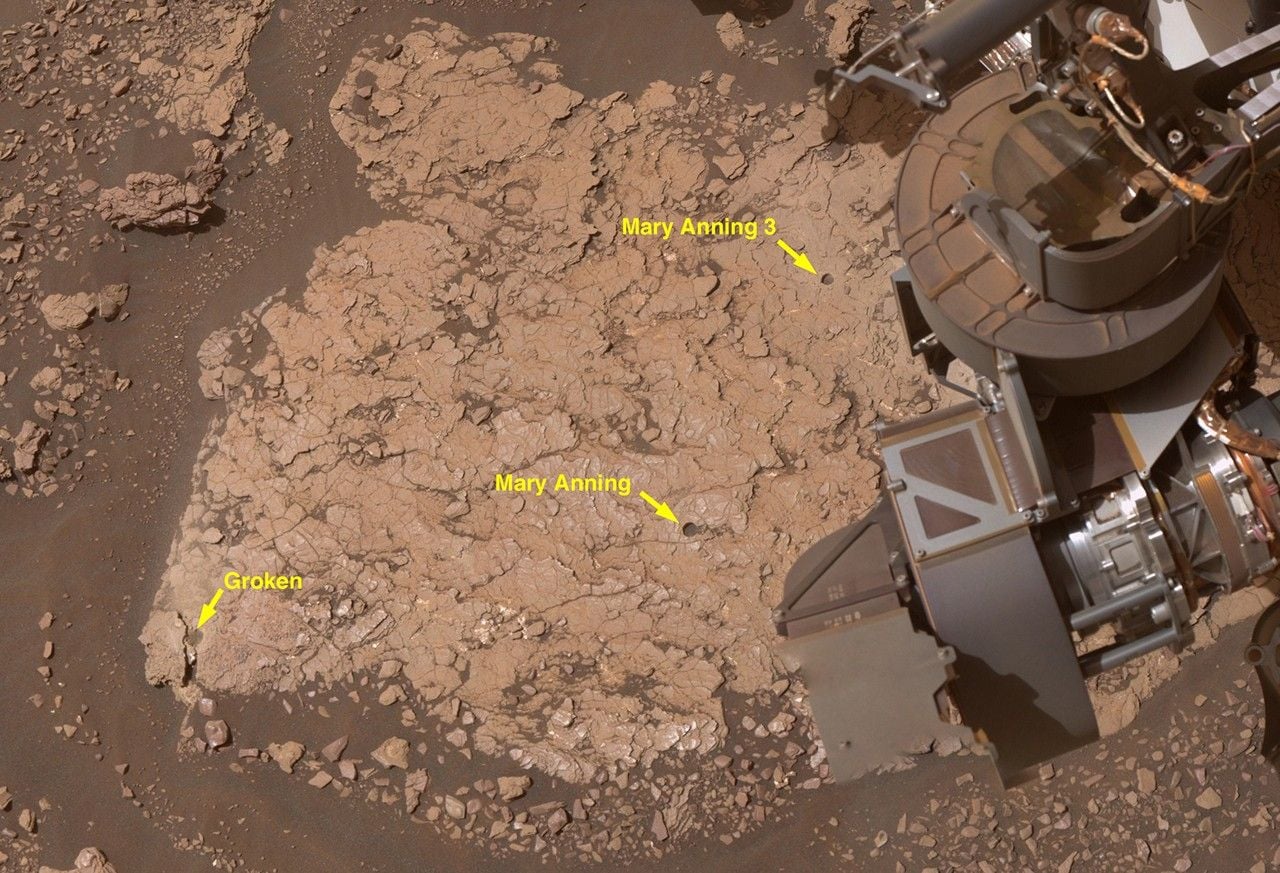
Curiosity detected a nitrogen-bearing molecule that appears just like an indole—one of many many precursor molecules that play a task in making DNA. Whereas Williams and her colleagues didn’t get good affirmation of it, it was an thrilling discovery.
“We don’t have DNA, we don’t have nucleobases, however it’s the primary time we’ve seen a nitrogen heterocyle like this on Mars, and it’s thrilling to see the [precursory], part constructing blocks for all times as we all know it,” Williams stated.
Deepening the seek for life off-Earth
The in-situ detection of those natural molecules is promising, however really confirming whether or not life as soon as existed on Mars would require extra proof.
“If you wish to really feel actually assured within the detection of life past Earth, I believe you want numerous corresponding strains of proof to return collectively to help that interpretation,” Williams stated.
Returning Mars samples to Earth would allow researchers to run analyses that NASA’s rovers aren’t able to, serving to verify the true nature and origin of those natural molecules. Samples collected by NASA’s Perseverance rover had been initially alleged to return to Earth within the early 2030s, however the mission has been effectively cancelled due to timeline and cost overruns.
Williams and her colleagues will nonetheless study a lot from sifting by way of the mountain of knowledge they gathered with Curiosity. Now that they’ve validated the TMAH evaluation method, it can play an necessary position on future missions, together with the European Space Agency’s Rosalind Franklin Mars rover and NASA’s Dragonfly mission, which is able to ship a rotorcraft to discover Saturn’s moon Titan. Each missions are at present set to launch in 2028.
“It’s thrilling to run the very first experiment that may hopefully set the stage for unbelievable discoveries to be made,” Williams stated. “And who is aware of what next-generation devices and experiments will assist us to dig deeper into the historical past of those planets.”
Trending Merchandise

Lenovo New 15.6″ Laptop, Inte...

Wireless Keyboard and Mouse Combo &...

Cooler Master Q300L V2 Micro-ATX To...

Acer Nitro KG241Y Sbiip 23.8” Ful...

TP-Link Smart WiFi 6 Router (Archer...

ASUS TUF Gaming 27″ 1080P Mon...

Sceptre 4K IPS 27″ 3840 x 216...

Acer Nitro 27″ 1500R Curved F...

Lian Li O11 Vision -Three Sided Tem...