Folks affiliate late ‘70s/early ‘80s gaming with Area Invaders and Pac-Man, however away from the arcades, you had been more likely to discover early residence laptop fanatics poring, and scratching their heads, over a really completely different kind of sport. Together with its religious predecessor Colossal Cave Journey, Zork and its sequels pioneered the style of the textual content journey, graphics-less parser-based video games which have seen a renaissance years below the extra intellectual title “interactive fiction.”
In addition to being the primary of a string of early- and mid-80s hits for its studio, Infocom, Zork was an actual achievement from a technical standpoint. The sport’s recognition was at the least partly as a consequence of its portability—it might run on a Commodore 64 as simply because it might run on a 8086 PC or a ZX Spectrum, which was an enormous benefit in an period the place shoppers might select between dozens of microcomputers, every largely incompatible with the others.
The sport’s versatility was as a consequence of Infocom’s forward-thinking choice to mainly run its titles in what it known as the Z-Machine—basically, a really early implementation of a digital machine. The sport and its successors had been written in Infocom’s proprietary high-level Zork Implementation Language, which was then compiled right into a lower-level instruction set known as Z-Code, which was executed by the Z-Machine surroundings. This meant that as a substitute of getting to rewrite their video games from scratch for each new system they needed to assist, Infocom had solely to put in writing a brand new Z-Code interpreter for every system. (For anybody , a bunch of fantastic documentation about how the Z-Machine labored will be discovered here.)
Anyway, now, virtually precisely 50 years after the discharge of the primary Zork sport, there’s a website that lifts the curtain on the Z-Machine in actual time. The Visible Zorker is the work of interactive fiction maven Andrew Plotkin, and it tracks the state of a sport whereas it’s operating, letting the participant see how the Z-Machine places their instructions into motion. The impact is moderately like operating a automotive with the hood open so that you could see precisely what urgent the fuel pedal does inside the engine—besides, y’know, safer.
Zorks I and II have been out there on the location for some time, however 1982’s Zork III was solely added on Might 1. It’s broadly thought of the toughest of the unique trilogy, and because it’s the one one I by no means solved first time round, I used to be fascinated to look into its inside workings.
So what’s there to see? Nicely, one attention-grabbing factor to do is to have a look at the inside workings of the parser. Zork’s parsing of enter actually isn’t good, and many people spent hours making an attempt to get the sport to know one thing we wish to strive doing. (Speech was a selected drawback for early parsers: instructions like “inform thief to return gold” or “Thief, return my gold” usually met with bewilderment: “I don’t perceive ‘gold’ in that context.”)
However, the Infocom parser is each easy and chic, particularly given the sport’s age. It depends on two easy lists: one in all verbs and one in all nouns. Most of those phrases have synonyms and abbreviations—“lamp” will work for “lantern,” “n” for “north,” and so forth—and there are additionally allowances made for spelling errors. Every verb has an related operate, a few of which require nouns as arguments, and a few which may work each methods. “Look” will return the outline of the present room, whereas “look [at] [noun]” will examine if the noun is current; if that’s the case, the operate will return the outline of the item in query, and if not, you’ll be instructed “You possibly can’t see any [noun] right here!”
There’s additionally assist for extra complexity, as we see right here:
This code offers with spraying a can of Frobozz Magic Grue Repellent. (Grues, as any fan is aware of, are monsters that lurk in the dead of night and can eat fools who enterprise into lightless areas with no torch or lantern.) Right here’s the way it works:
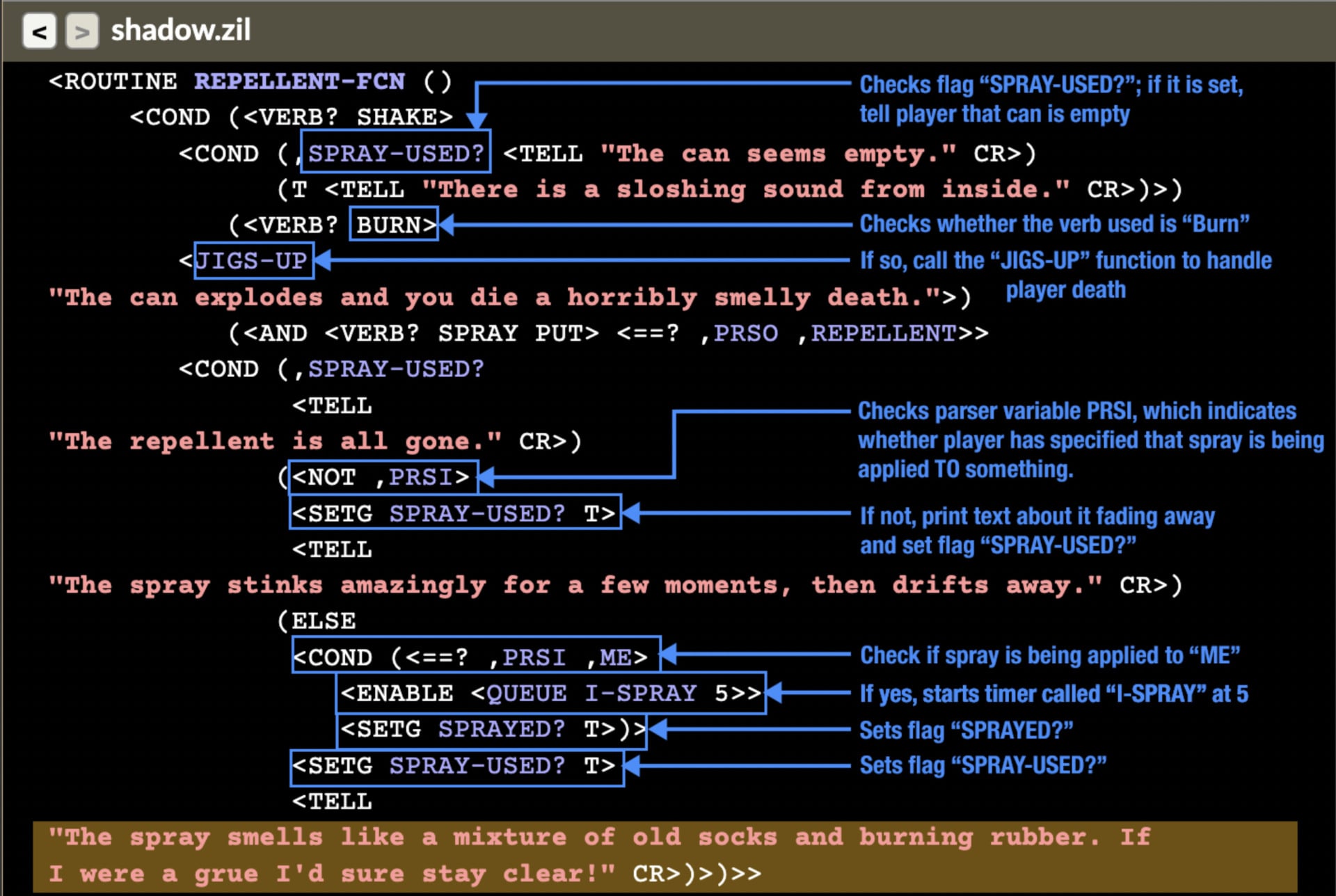
The sport first checks if the can is empty. If not, it checks to see in the event you’ve stated “Burn can,” by which case you blow your self up and it’s sport over. In any other case, it’s onto seeing the place you’re spraying the can. In case you don’t specify a location, the sport assumes you’re simply spraying it into the air, by which case it’s mainly wasted. (Notice additionally that the sport helps you out a bit right here—in the event you simply enter “Spray can,” it asks what you wish to spray the can on.)
Anyway, you spray the can on your self, then you definately’re shielded from grues for 5 turns. The sport begins a timer (“I-SPRAY,” which tracks what number of turns it’s been because you sprayed your self) and units a few flags: “SPRAYED?,” which tracks whether or not you’ve sprayed your self and “SPRAY-USED?,” which tracks whether or not the can has been emptied. We additionally see right here how simply you will get the sport into an unwinnable state: in the event you spray the repellent on one thing that isn’t your self, then you definately’re shit out of luck.
If there’s one factor specifically for which Zork III is remembered, it’s the infamous Royal Puzzle, a life-sized model of a type of puzzles the place it’s a must to slide tiles round a grid. Fixing a puzzle like this may be tough sufficient in a sport with a graphical illustration of the surroundings; fixing it in a parser-based textual content sport, even with the rudimentary support the sport provides you, requires the spatial consciousness of some kind of architectural savant and/or the persistence of a saint.
Having neither of these items meant that Zork III was the one Zork sport I didn’t resolve as a child, and I used to be to see how the sport stored monitor of the puzzle’s varied elements and their respective areas. It seems that fairly a big portion of the sport’s code is dedicated to the puzzle, referred to internally because the “Chinese language puzzle.” Every place within the 6×6 grid is saved as a single quantity in a 36-element array, with the place of varied partitions being up to date because the participant strikes them.
You would possibly suppose that there can be 36 rooms inside the puzzle, however no—there’s just one, presumably as a result of including 36 largely equivalent rooms to the sport can be a waste of reminiscence. (For reference, there are 60 or so rooms in the complete remainder of the sport.) The one puzzle room is at all times the room housing the participant, which requires the sport to maintain monitor of issues like gadgets and swap them out and in of the room as essential: let’s say you drop your sword within the room with co-ordinates x: 3 y:4, then transfer east. You don’t truly transfer in any respect—the sport simply updates your place to x:4 y:4 and removes the sword. In case you transfer west once more, the sport remembers that that is the room by which you dropped the sword, so it updates your place once more and returns the sword to the room.
Optimizations like this are vital once you’re working with the kind of house constraints that the early Nineteen Eighties imposed—and people constraints had been fairly extreme. Everything of Zork III’s supply code—which incorporates the verb/noun lists, the room and object descriptions, the parser, the ZIL interpreter and the precise sport code—weighs in at 92 KB. In whole. It’s not fairly Crimson Desert.
Nonetheless, it’s additionally attention-grabbing to have a look at the numerous similarities between how Zork III and trendy video games work. Finally, a sport is only a assortment of state variables: has a participant been to this room but? Have they killed this monster? Have they talked to this NPC and been given this quest? How far together with the search are they? What are they carrying proper now? What degree is their well being at? How has the sport world modified for the reason that sport started?
The methods by which a contemporary sport handles such issues can actually be much more nuanced than in 1982—Zork has nothing like multi-stage quests, as an illustration—however the rules are basically the identical. Set flag [x] if vital occasion [y] has occurred. Hold monitor of what’s within the participant’s stock. Hold monitor of timers. The participant simply acquired hit by a monster? Subtract [x] from their well being. Is their well being now below 0? Sure? Oh expensive. It’s time to run the operate JIGS-UP after which restore their final savegame.
In that respect, there’s little or no distinction between Zork and Elden Ring. Positive, the implementations of those ideas are worlds aside, however the ideas themselves stay the identical.
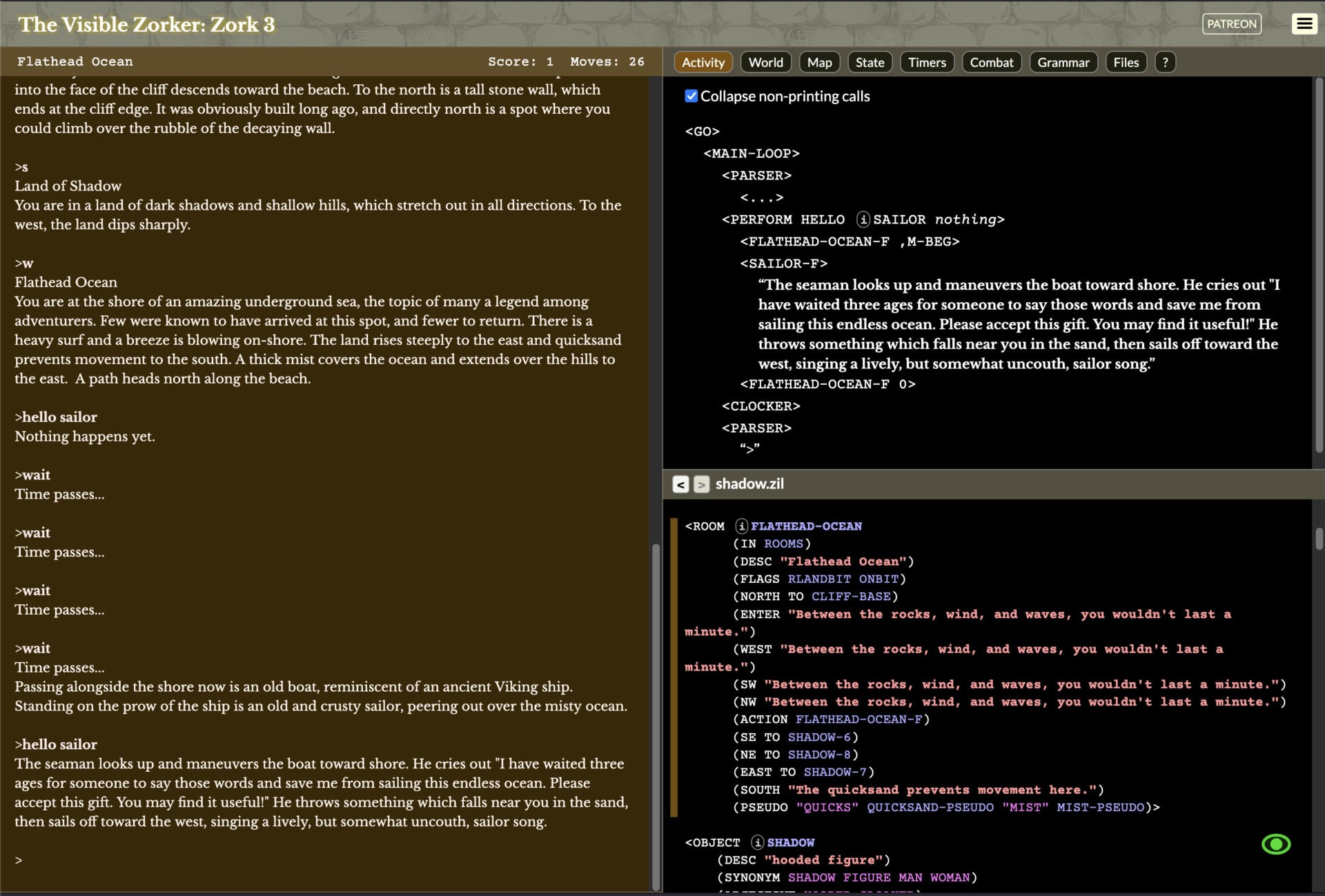
Oh, and at last: as any Zork fan is aware of, one factor it’s a must to strive in each sport is typing, “Hello sailor”—it’s kinda just like the Zork-ish equal of the Konami cheat code, insofar because it’s one thing you strive coming into within the expectation that one thing would possibly occur because of this. The factor is, all all through Zork (the place the phrase is first encountered) and Zork II, the one response you ever get is “Nothing occurs right here.” The implication is that one thing will occur someplace else, but it surely by no means does. Nonetheless! In Zork III, there’s one location the place that message turns into “Nothing occurs but.” And in the event you wait lengthy sufficient, then lo and behold: cometh the hour, cometh the traditional mariner!
Trending Merchandise

Lenovo New 15.6″ Laptop, Inte...

Wireless Keyboard and Mouse Combo &...

Cooler Master Q300L V2 Micro-ATX To...

Acer Nitro KG241Y Sbiip 23.8” Ful...

TP-Link Smart WiFi 6 Router (Archer...

ASUS TUF Gaming 27″ 1080P Mon...
Sceptre 4K IPS 27″ 3840 x 216...

Acer Nitro 27″ 1500R Curved F...

Lian Li O11 Vision -Three Sided Tem...